Top Emergency Fund Savings Account Options for Financial Security
emergency fund savings account options

Top Emergency Fund Savings Account Options for Financial Security

Discover the ideal savings solutions to fortify your financial future against unexpected life events and achieve peace of mind.

Find Your Perfect Account

Key Takeaways

  • ✓ An emergency fund should cover 3-6 months of essential living expenses.
  • ✓ High-yield savings accounts are often the best choice due to liquidity and interest rates.
  • ✓ FDIC insurance protects your deposits up to $250,000 per depositor, per institution.
  • ✓ Accessibility and interest rate are key factors when choosing an emergency fund account.

How It Works

1
Assess Your Needs

Calculate 3-6 months of essential living expenses to determine your emergency fund goal. This amount will be your target for savings.

2
Research Account Types

Explore different emergency fund savings account options like high-yield savings, money market, or even short-term CDs. Compare their features and benefits.

3
Choose and Open Account

Select the account that best fits your liquidity needs and interest rate preferences. Open the account and link it to your primary checking for easy transfers.

4
Automate & Fund

Set up automatic transfers from your checking account to your emergency fund. Consistently contribute until you reach your savings goal, then maintain it.

Understanding the Importance of an Emergency Fund

A piggy bank on euro bills with 'save' text highlights money saving concepts. Photo: Marta Branco / Pexels
In the unpredictable landscape of life, an emergency fund acts as your financial fortress, shielding you from unexpected storms. It's not merely a savings account; it's a strategic financial tool designed to provide peace of mind and prevent debt when unforeseen circumstances arise. Think of it as your personal financial insurance policy, ready to deploy when life throws a curveball – a sudden job loss, an unexpected medical emergency, a major car repair, or a home appliance breakdown. Without an emergency fund, these events can quickly spiral into significant financial distress, forcing you to rely on high-interest credit cards, personal loans, or even deplete your retirement savings. The core principle is simple: separate these funds from your everyday spending and invest them in a highly liquid, accessible account. The recommended size of an emergency fund typically ranges from three to six months' worth of essential living expenses. For some, especially those with less stable income or dependents, even nine to twelve months might be prudent. Calculating this amount involves a detailed assessment of your non-negotiable monthly outgoings – rent/mortgage, utilities, food, transportation, insurance, and minimum debt payments. It's crucial to distinguish between 'needs' and 'wants' when tallying these expenses; the goal is to cover survival, not luxury. The psychological benefit of having an emergency fund is immense. It reduces financial stress, allows you to make rational decisions during crises rather than emotional ones, and provides a sense of security that permeates all aspects of your financial life. It empowers you to navigate tough times without derailing your long-term financial goals, such as saving for a down payment or retirement. Building this fund requires discipline and consistency, but the payoff in terms of financial resilience is immeasurable. Therefore, selecting the right emergency fund savings account options is a critical first step in establishing this vital financial safety net. It's about finding the balance between accessibility, safety, and earning potential, ensuring your money is there when you need it most, without being eroded by inflation or inaccessible due to penalties. For more insights on general savings strategies, consider exploring effective savings techniques.

High-Yield Savings Accounts: The Go-To Option
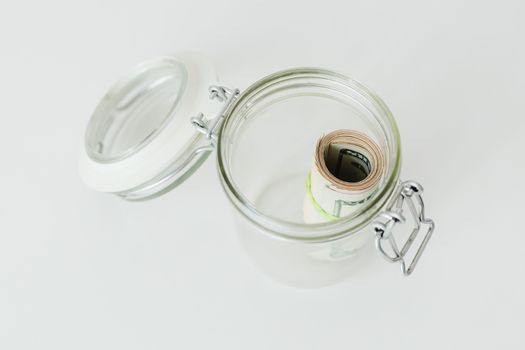
Close-up shot of rolled US dollar bills inside a glass jar on a white surface. Photo: www.kaboompics.com / Pexels
When considering emergency fund savings account options, high-yield savings accounts (HYSAs) frequently emerge as the top recommendation, and for good reason. These accounts offer a compelling blend of accessibility, safety, and competitive interest rates, making them ideal for storing your crucial emergency reserves. Unlike traditional savings accounts at brick-and-mortar banks, HYSAs are predominantly offered by online banks, which have lower overhead costs. These savings are often passed on to consumers in the form of significantly higher Annual Percentage Yields (APYs). While the rates fluctuate with the broader economic environment, HYSAs consistently outperform standard savings accounts, allowing your emergency fund to grow, albeit modestly, and combat the effects of inflation. The primary advantages of HYSAs for an emergency fund are their liquidity and FDIC insurance. Your funds are readily accessible, typically within one to three business days for transfers to a linked checking account. This quick access is paramount in an emergency, where immediate funds might be necessary. Furthermore, HYSAs, like all legitimate savings accounts in the U.S., are insured by the Federal Deposit Insurance Corporation (FDIC) up to $250,000 per depositor, per insured bank. This means your money is safe, even if the bank were to fail, providing an essential layer of security. While HYSAs offer superior interest rates compared to traditional savings, it's important to manage expectations; they are not investment vehicles designed for aggressive growth. Their purpose is preservation and modest growth, not wealth creation. Some HYSAs may have minimum balance requirements or transaction limits, though these are typically more generous than money market accounts. It's wise to review the terms and conditions of any HYSA before opening. Look for accounts with no monthly fees, no minimum balance to earn the advertised APY, and easy online access. The convenience of managing your emergency fund online, often through intuitive apps and websites, adds another layer of appeal to HYSAs, making them a cornerstone of sound financial planning for emergencies.

Exploring Alternative Emergency Fund Savings Account Options

Businesswoman counting dollar bills with financial charts and laptop on table. Investment and finance concept. Photo: Yan Krukau / Pexels
While high-yield savings accounts are often the gold standard for emergency funds, it's worth exploring other emergency fund savings account options that might suit specific needs or preferences. Money market accounts (MMAs) share many similarities with HYSAs but often come with additional features. MMAs typically offer competitive interest rates, though sometimes slightly lower than the top HYSAs, and are also FDIC-insured. A key differentiator is that MMAs often include limited check-writing privileges and a debit card, offering slightly more direct access to funds than a pure savings account. However, they usually come with stricter transaction limits (often six per month) and may have higher minimum balance requirements to avoid fees or earn the best rates. For those who might need to access their emergency funds via check or debit card in very specific scenarios, an MMA could be a viable alternative, but the added complexity and potential fees should be weighed against the simplicity and often higher rates of HYSAs. Another option, albeit one requiring more strategic planning, is a Certificate of Deposit (CD) ladder. A CD ladder involves dividing your emergency fund into several CDs with staggered maturity dates (e.g., 3-month, 6-month, 9-month, 12-month CDs). This strategy aims to capture higher interest rates typically offered by longer-term CDs while maintaining some liquidity as each CD matures. As one CD matures, you can either roll it into a new, longer-term CD or access the funds if needed. The downside is that funds are locked up until maturity, and early withdrawal penalties can erode interest earnings or even principal. Therefore, a CD ladder is generally not recommended for the entirety of an emergency fund, but perhaps for a portion of a very large fund that exceeds immediate needs. For instance, if you have 12 months of expenses saved, you might put 3-6 months in a HYSA and ladder the remaining 6 months in CDs. It's crucial to remember that the primary goal of an emergency fund is accessibility and safety, not maximizing returns. Any option chosen must prioritize these two factors above all else. For those looking to optimize their overall financial strategy, understanding different investment vehicles can provide a broader perspective on managing money beyond just emergency savings.

Choosing the Best Account and Avoiding Common Mistakes
Close-up of tax forms and a small business accounting checklist on a laptop. Photo: Leeloo The First / Pexels
Selecting the optimal emergency fund savings account options involves a careful evaluation of your personal financial situation and risk tolerance. Here's a guide to making the best choice and steering clear of common pitfalls: **Key Factors for Selection:** * **Interest Rate (APY):** Look for the highest Annual Percentage Yield possible without sacrificing other critical features. Even a small difference can add up over time. * **Accessibility:** How quickly can you access your funds? Online transfers, ATM access, or check-writing capabilities vary. Ensure it meets your potential emergency needs. * **Fees:** Scrutinize monthly maintenance fees, transaction fees, and minimum balance fees. The goal is to grow your money, not pay to keep it. * **FDIC Insurance:** Always confirm that the institution is FDIC insured. This protects your deposits up to $250,000 per depositor, per institution, ensuring your money's safety. * **Convenience:** Consider the ease of setting up automatic transfers, managing the account online or via mobile app, and linking it to your primary checking account. **Common Mistakes to Avoid:** * **Keeping Funds in a Regular Checking Account:** While highly liquid, checking accounts offer little to no interest, allowing inflation to erode your savings' purchasing power. * **Investing in Volatile Assets:** Stocks, mutual funds, or cryptocurrencies are unsuitable for emergency funds due to their inherent market volatility. You cannot risk your emergency money decreasing in value when you need it. * **Not Automating Savings:** Without automatic transfers, it's easy to neglect funding your emergency account. Set it and forget it until you reach your goal. * **Underfunding Your Account:** Don't stop at just one month's expenses. Aim for the recommended 3-6 months, or more, to be truly prepared for significant emergencies. * **Mixing Emergency Funds with Other Savings Goals:** Keep your emergency fund separate from vacation savings, down payment funds, or retirement accounts. This prevents 'borrowing' from your emergency fund for non-emergencies. * **Ignoring Interest Rate Changes:** Periodically review your account's APY. If rates at other institutions have significantly increased, consider moving your funds to a more competitive HYSA. By carefully considering these factors and avoiding these common missteps, you can ensure your emergency fund is robust, accessible, and ready to protect you when life's unforeseen challenges arise.

Comparison

FeatureHigh-Yield Savings AccountMoney Market AccountCD Ladder (Short-Term)
Typical APYHigh (0.50% - 5.00%+) Moderate (0.20% - 4.00%+) Moderate to High (1.00% - 5.50%+)
LiquidityExcellent (1-3 business days)Very Good (check/debit access, limits)Limited (staggered maturities)
FDIC Insured
Transaction LimitsTypically 6 per monthTypically 6 per monthNone (after maturity)
Minimum BalanceOften low or noneOften higher to avoid feesVaries by CD, often $500-$1000+
FeesGenerally low/noneCan have monthly feesEarly withdrawal penalties
Best ForPrimary emergency fundEmergency fund with check accessPortion of very large fund

What Readers Say

"Opening a high-yield savings account for my emergency fund was a game-changer. I earn way more interest than my old bank and the money is still super easy to access. It's truly one of the best emergency fund savings account options out there."

Sarah J. · Austin, TX

"I used to keep my emergency money in checking, but after reading about emergency fund savings account options, I moved it to an online HYSA. The peace of mind knowing it's growing and separate is invaluable."

David M. · Chicago, IL

"Thanks to setting up an automatic transfer to my high-yield savings, I built a 6-month emergency fund in just over a year. When my car broke down, I paid cash instead of going into debt. This strategy truly works!"

Emily R. · Denver, CO

"While I appreciate the higher interest from my HYSA, I do miss the convenience of a local branch sometimes. Still, for an emergency fund, the benefits of the interest rate and FDIC insurance outweigh that minor inconvenience."

Mark T. · Miami, FL

"My financial advisor recommended a money market account for my emergency savings due to the check-writing feature. It's been great for the few times I've needed to access funds quickly without waiting for a transfer."

Jessica L. · Seattle, WA

Frequently Asked Questions

What is the ideal amount to have in an emergency fund?

Most financial experts recommend saving three to six months' worth of essential living expenses in your emergency fund. However, for individuals with unstable income, dependents, or high-deductible health plans, extending this to nine or even twelve months can provide greater security and peace of mind.

Is my emergency fund safe in an online high-yield savings account?

Yes, absolutely. As long as the online bank is FDIC-insured, your deposits are protected up to $250,000 per depositor, per institution. This federal insurance provides the same level of safety as traditional brick-and-mortar banks, making online HYSAs a very secure option.

How do I start building my emergency fund?

Begin by calculating your essential monthly expenses to set a target. Then, open a dedicated high-yield savings account separate from your checking. Set up automatic transfers from your checking account to your emergency fund each payday, even if it's a small amount to start. Increase the transfer amount as your budget allows.

Are there any fees associated with emergency fund savings account options?

Many high-yield savings accounts and some money market accounts offer no monthly maintenance fees, especially if you meet certain minimum balance requirements or set up direct deposit. However, always review the fee schedule for potential charges like excessive transaction fees or wire transfer fees before opening an account.

How do emergency fund savings account options compare to investing in the stock market?

Emergency fund savings account options prioritize safety and liquidity over high returns. They are designed to be stable and accessible. Investing in the stock market, while offering potential for higher growth, comes with significant risk and volatility, making it unsuitable for funds you might need immediately or that cannot afford to decrease in value.

Who should prioritize building an emergency fund?

Everyone should prioritize building an emergency fund, regardless of income level. It's particularly crucial for individuals with variable incomes, those in jobs with high layoff potential, single-income households, or anyone with significant financial obligations like a mortgage or dependents. It's a foundational step in personal finance.

What happens if I need to use my emergency fund?

If a true emergency arises, you can typically transfer funds from your emergency savings account to your linked checking account within 1-3 business days. Once the emergency is resolved, your priority should be to replenish the fund as quickly as possible, restarting your automatic contributions.

Will interest rates on emergency fund accounts always be high?

Interest rates on emergency fund savings account options, especially high-yield savings and money market accounts, are variable and tied to broader economic conditions and the Federal Reserve's interest rate policies. While they generally offer competitive rates, they can fluctuate over time. It's wise to periodically check rates and consider moving your funds if significantly better options emerge.

Take control of your financial future today by choosing the right emergency fund savings account options. Start building your safety net and gain the confidence that comes with true financial preparedness.

Topics: emergency fund savings account optionshigh-yield savings accountmoney market accountCD ladderonline savings accounts
Leo List
Brampton weed
Adultwork EstrelaBet Vai de Bet R7 Bet Betão Galera Bet Rainbet Bet9ja Shop SportyBet BetKing Sisal Loto Foot Hollywoodbets YesPlay Odibets RushBet Jugabet BetWarrior BetCity MSport betPawa Fortebet